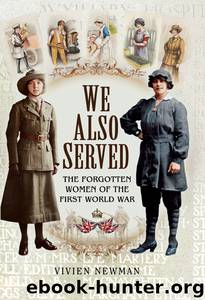
We Also Served by Vivien Newman
Author:Vivien Newman
Language: eng
Format: epub
Tags: HISTORY / Military / World War I
ISBN: 9781473845275
Publisher: Pen & Sword Books
Published: 2014-11-29T16:00:00+00:00
CHAPTER 5
‘We Too Wore Khaki’:
Servicewomen on the Home and War Fronts
‘I was a first day volunteer,’
(Waac Ada Gummershall)
Images of young men from across the social spectrum of Great Britain and her Empire flocking to the recruiting stations on the day war was declared are seared into our collective consciousness. Women, despite the military’s perception of their lack of usefulness to a nation at war, also found ways to wear a khaki uniform and contribute to the ‘Great War for Civilisation’.
‘Neither Fish, Flesh nor Fowl, but Thundering Good Red Herring’: The First Aid Nursing Yeomanry
Lying wounded on the South African veldt during the Boer War, Sergeant Edward Baker visualised a female nurse galloping across the field on horseback and delivering him to a military dressing-station. Out of this vision, the First Aid Nursing Yeomanry, or FANY as it was soon dubbed, was born in 1907. Drilled by Edward Baker in cavalry techniques, horse-drawn ambulance driving, stretcher-bearing and first aid, the FANY soon began to attract press interest.
The February 1909 Daily Graphic referred to these ‘aristocratic amazons-in-arms’, who looked ‘dashing in their scarlet’ and included amongst their members ‘Lady Ernestine Hunt, the eldest daughter of the Marquis of Aylesbury’. The doings of aristocrats sold newspapers and the FANY was definitely an upper/upper middle-class organisation, comprising about 100 members, each personally recommended by an existing member. They paid yearly membership fees of a guinea and were trained in first aid, horsemanship, veterinary work, signalling and camp cookery. They attended an annual camp, providing their own horses and uniforms, thereby deftly excluding less socially privileged recruits who had neither the mount nor the financial wherewithal to fund membership.
The initial rather glamorous uniform of dark blue riding skirts with a military-style scarlet tunic and cap was soon superseded by a daring button-through khaki skirt, which revealed elegant breeches for riding astride. One woman (whose service with the FANY was short-lived) ensured that her frilly white drawers were visible under her khaki skirt. A fur coat would eventually be added, as FANYs toiled through the biting winters of 1917 and 1918 driving ambulances whose windscreens had been removed to prevent possible injuries caused by flying glass.
By 1910, this first-ever officially recognised, uniformed women’s service was well established and, although early members sometimes ‘felt like freaks’ when parading in uniform, they relished the occasional salute thrown by soldiers and military personnel. Free-spirited and with the confidence that their social status almost automatically bestowed on them, these women were generally endowed with a sense of humour and a desire to push the boundaries of Edwardian femininity. By 1912, Baker (who had elevated himself to the rank of Captain) fades from the scene; it is possible that his gender and his class lost him favour, as some FANYs considered him a social upstart.
Many FANYs were skilled drivers as well as horsewomen, and a number had won automobile races ‘on’ (the terminology used at the time) their fathers’ or even their own vehicles. Their driving rather than their horsemanship skills would stand them in excellent stead in the years ahead.
Download
This site does not store any files on its server. We only index and link to content provided by other sites. Please contact the content providers to delete copyright contents if any and email us, we'll remove relevant links or contents immediately.
| Africa | Americas |
| Arctic & Antarctica | Asia |
| Australia & Oceania | Europe |
| Middle East | Russia |
| United States | World |
| Ancient Civilizations | Military |
| Historical Study & Educational Resources |
Cecilia; Or, Memoirs of an Heiress — Volume 1 by Fanny Burney(32558)
Cecilia; Or, Memoirs of an Heiress — Volume 2 by Fanny Burney(31956)
Cecilia; Or, Memoirs of an Heiress — Volume 3 by Fanny Burney(31940)
The Secret History by Donna Tartt(19083)
Sapiens: A Brief History of Humankind by Yuval Noah Harari(14389)
Leonardo da Vinci by Walter Isaacson(13336)
The Radium Girls by Kate Moore(12026)
Sapiens by Yuval Noah Harari(5369)
How Democracies Die by Steven Levitsky & Daniel Ziblatt(5218)
The Wind in My Hair by Masih Alinejad(5095)
Homo Deus: A Brief History of Tomorrow by Yuval Noah Harari(4918)
Endurance: Shackleton's Incredible Voyage by Alfred Lansing(4780)
Man's Search for Meaning by Viktor Frankl(4604)
The Silk Roads by Peter Frankopan(4532)
Millionaire: The Philanderer, Gambler, and Duelist Who Invented Modern Finance by Janet Gleeson(4478)
The Rape of Nanking by Iris Chang(4211)
Joan of Arc by Mary Gordon(4109)
The Motorcycle Diaries by Ernesto Che Guevara(4098)
Stalin by Stephen Kotkin(3965)
